Seoul Public Transportation: Choose Your Card and Make Your First Trip
A Tmoney card lets you pay per journey on Seoul public transportation; a short-term Climate Card gives unlimited rides within its defined service area. Choose by your actual routes, then buy and recharge the right card. Here are the fares, first-journey steps, transfer conditions and Incheon Airport exception, including the ended recharge period for old 30-day passes.
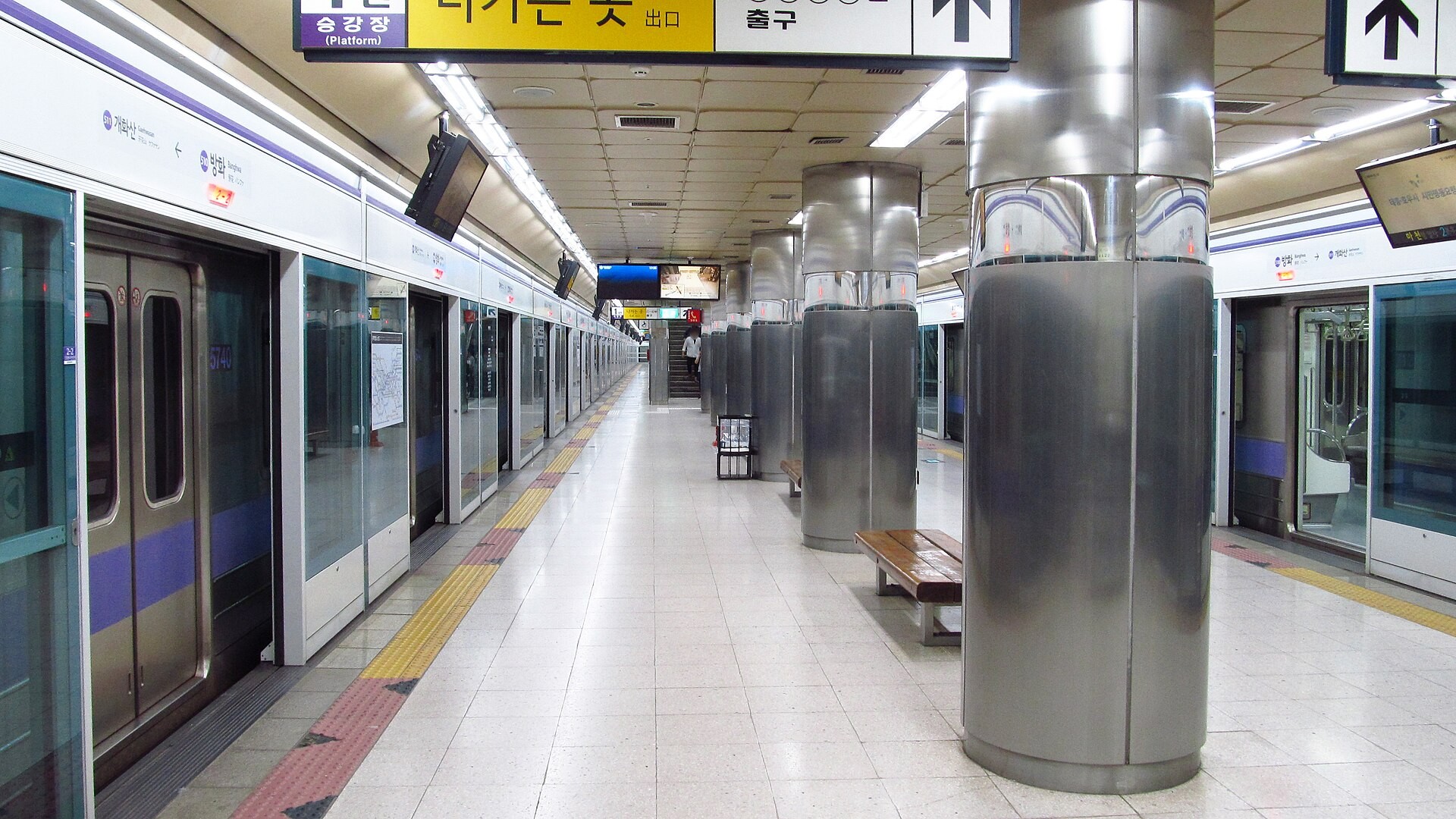
Photo credit
LERK / CC BY-SA 4.0. Resized/cropped for display; the photograph retains its license.

Tmoney vs Climate Card: Which One Fits Your Trip?
The two cards serve different travel patterns. Tmoney is a pay-as-you-go card: you load a balance, and the fare is deducted each time you tap in and out. It works on Seoul's subway, city buses, most taxis, and at some convenience stores and traditional markets. There is no expiration date on an unused balance, making it practical for short or irregular visits.
The Climate Card is an unlimited-ride option within a defined service area. For short visits, the Seoul Metropolitan Government lists passes lasting 1, 2, 3, 5 or 7 days. The official coverage page includes Seoul-licensed transit and town buses, including night buses, and specified subway sections. Choose using that service-range list rather than assuming every line or bus in greater Seoul is included.
September 2026 update: the official notice sets August 31, 2026 as the last recharge date for the old 30-day prepaid Climate Card. That deadline has passed. The same notice says existing cards can still be recharged with short-term passes. It announced a replacement Climate Pass for September 1, but that announcement alone is not confirmation of its current availability. For a short visit, compare the listed short-term passes with pay-as-you-go travel.
Choose Tmoney for individual journeys across accepting transport and retail services. Consider a short-term Climate Card when your mapped routes and travel dates fit its coverage and duration.
| Feature | Tmoney | Climate Card |
|---|---|---|
| How you pay | Per journey; balance deducted | Flat fee for unlimited rides on covered routes |
| Pass types | Pay-as-you-go only | Short-term: 1, 2, 3, 5 or 7 days, including recharge on existing cards. Old 30-day recharge ended August 31, 2026. |
| Taxis | Accepted | Not covered (pay separately) |
| Sinbundang Line | Per-journey fare applies | Excluded |
| Expiration | No expiry on balance | Validity tied to pass duration |
Official reference: english.seoul.go.kr · english.visitseoul.net
Where to Buy Each Card and How to Pay
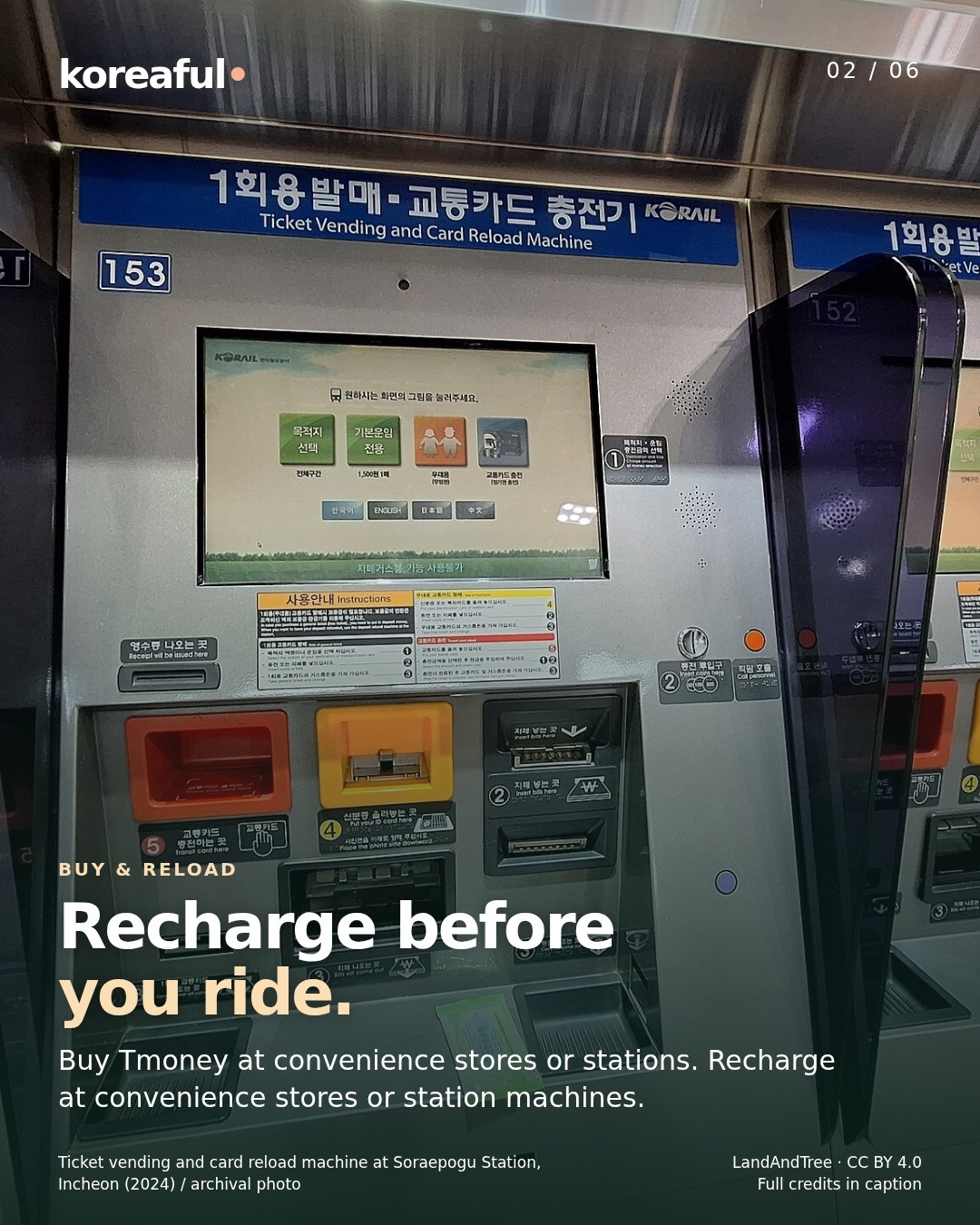
Tmoney cards are sold at most convenience stores, subway stations, and tourist information centers. According to Visit Seoul, the card can be purchased for KRW 3,000 and loaded with any amount you choose. Recharge locations include convenience stores, vendor stalls, the Tmoney Pay app, subway station machines, and bank ATMs. The photograph shows a ticket and reload machine at Soraepogu Station in Incheon in 2024; Climate Card purchase locations are specified separately below.
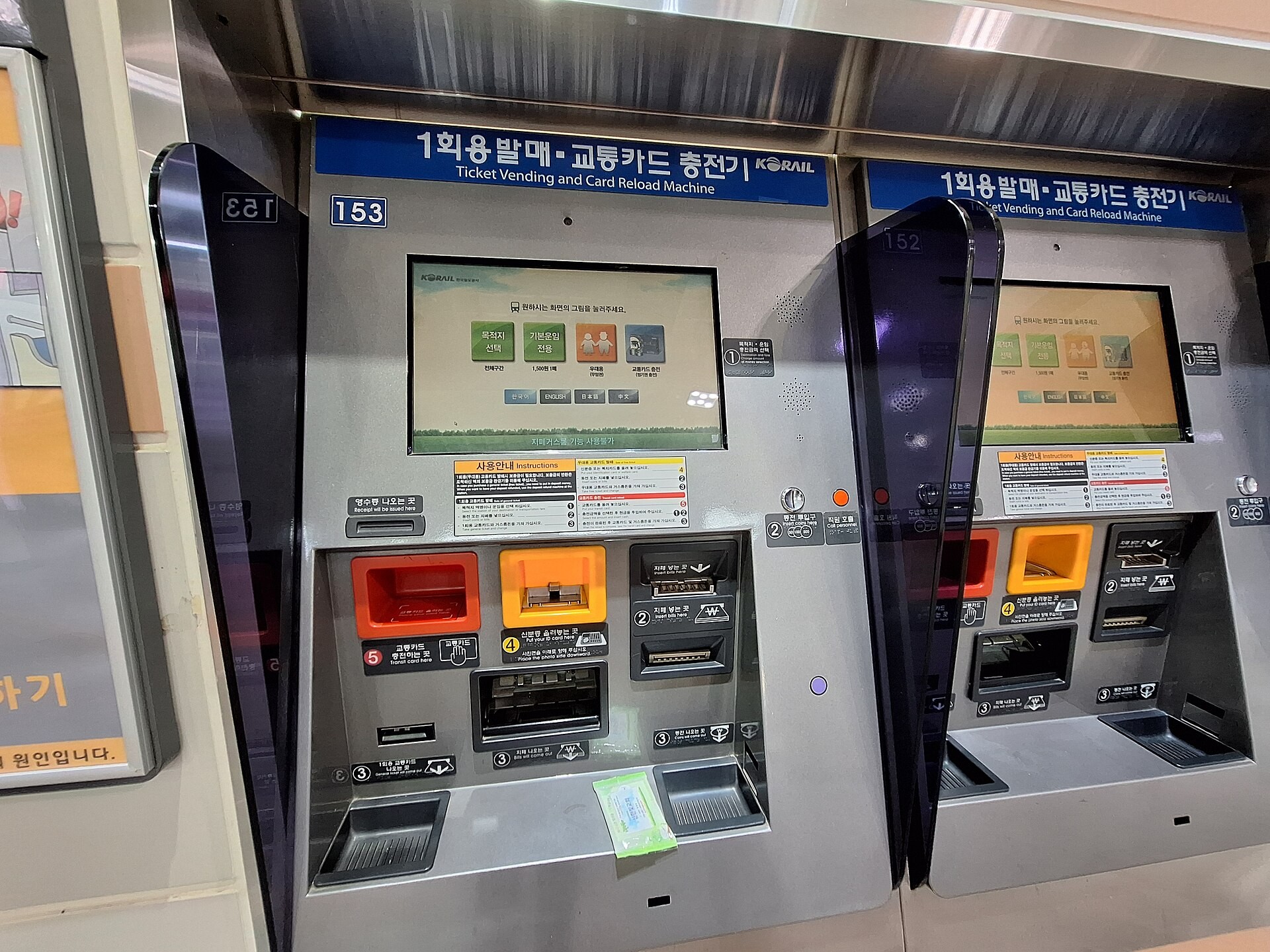
Photo credit
LandAndTree / CC BY 4.0. Resized/cropped for display; the photograph retains its license.

Physical Climate Cards are available at new card vending machines inside Seoul Metro Lines 1–8 subway stations, with availability also noted at convenience stores near stations on Line 9, Ui-Sinseol Line, and Sillim Line, according to the Seoul Metropolitan Government. The physical card costs KRW 3,000 separately on top of the pass price. Starting March 20, 2025, Climate Cards can be purchased and recharged using international credit and debit cards at those machines — short-term passes included. Cash and domestic credit or debit cards are also accepted; corporate cards are not.
Once you have a physical Climate Card, you must register it online via the Tmoney Card & Pay website (a QR code is printed on the back of the card). Refunds and Ttareungi access are unavailable for unregistered cards. Mobile Climate Cards are available for Android users running OS 12 or higher via the Mobile Tmoney app; iOS users must use a physical card.
Official reference: english.seoul.go.kr · english.visitseoul.net
Making Your First Subway Journey
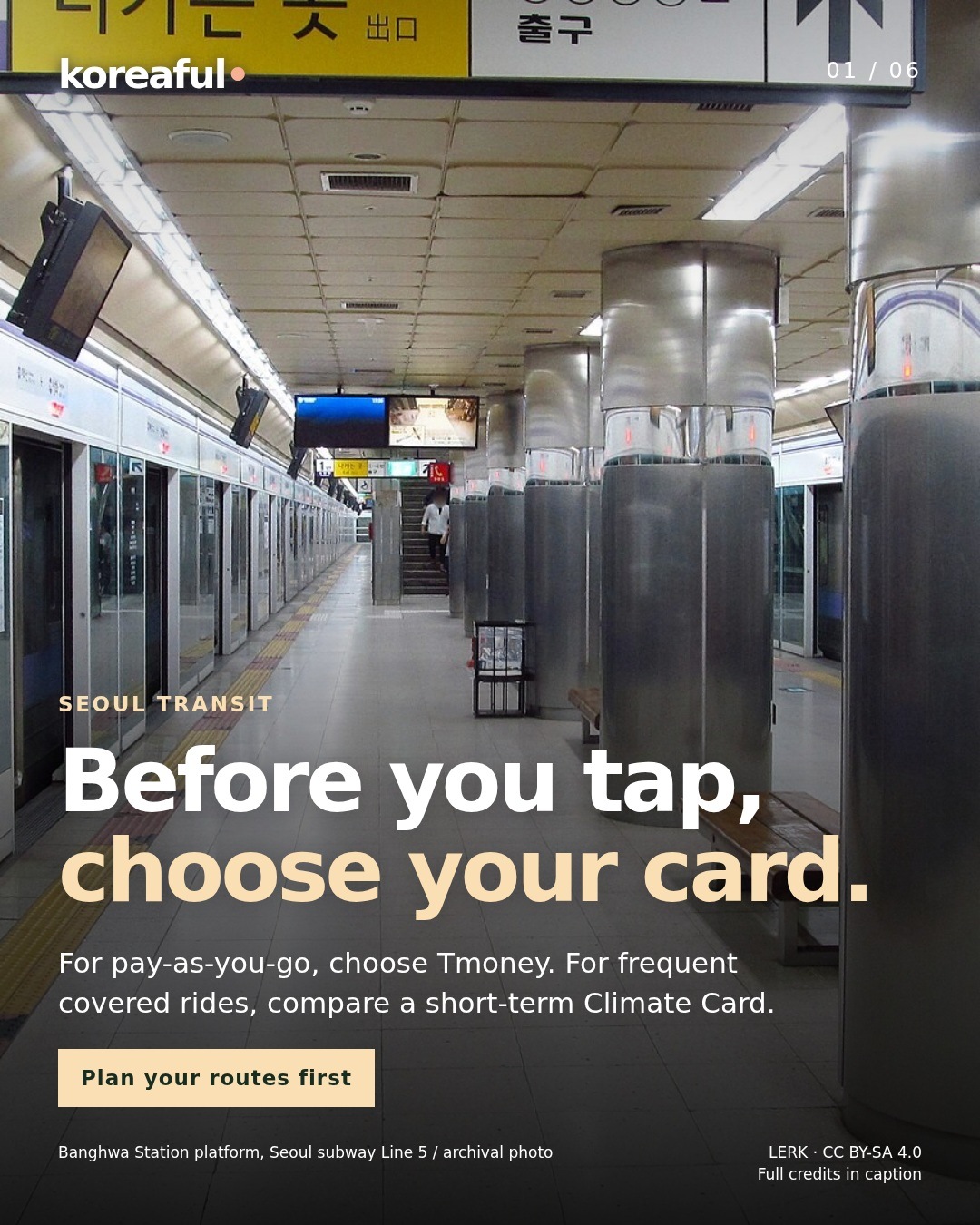
Seoul subway stations use color-coded signs in Korean, English and Chinese. Visit Seoul describes general operating hours as approximately 5:30 am to midnight; use the timetable for your own journey when a first or last train matters. Note the exit number for your destination alongside its station name.
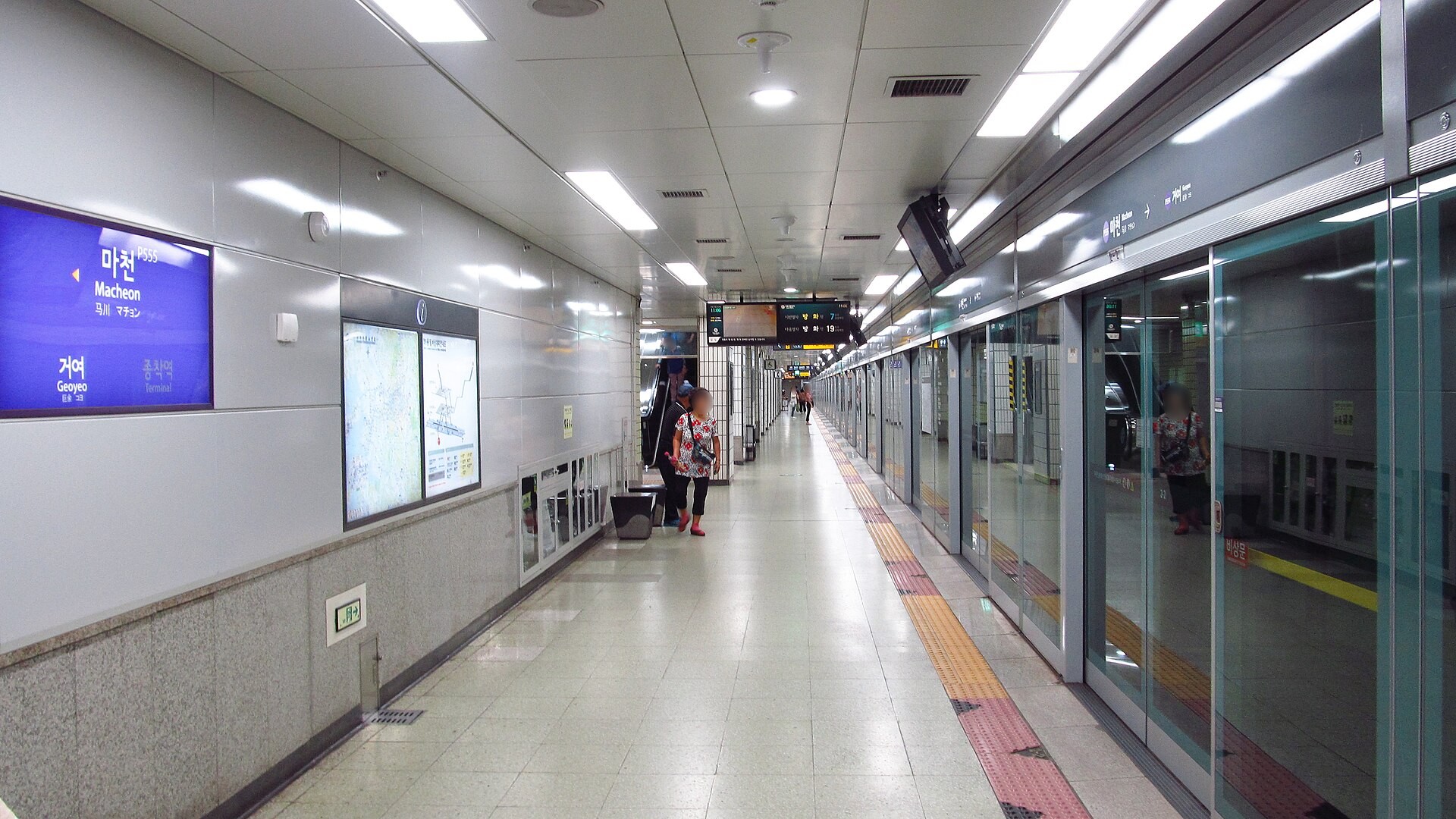
Photo credit
LERK / CC BY-SA 4.0. Resized/cropped for display; the photograph retains its license.

Tap a valid, charged transport card when entering and leaving through the gates. For the Climate Card specifically, Seoul states that two failures to tap out trigger a 24-hour suspension from the last boarding. The exit tap also matters for Tmoney transfer benefits, but the Climate Card suspension rule should not be confused with Tmoney conditions.
If you need a single-journey ticket instead, use the vending machines inside the station. Visit Seoul's instructions: select the English menu, choose Single Journey Ticket, select your destination, choose the number of passengers, and insert the fare plus a KRW 500 refundable deposit. Return the card to a Deposit Refund Device at your destination to claim the deposit back.
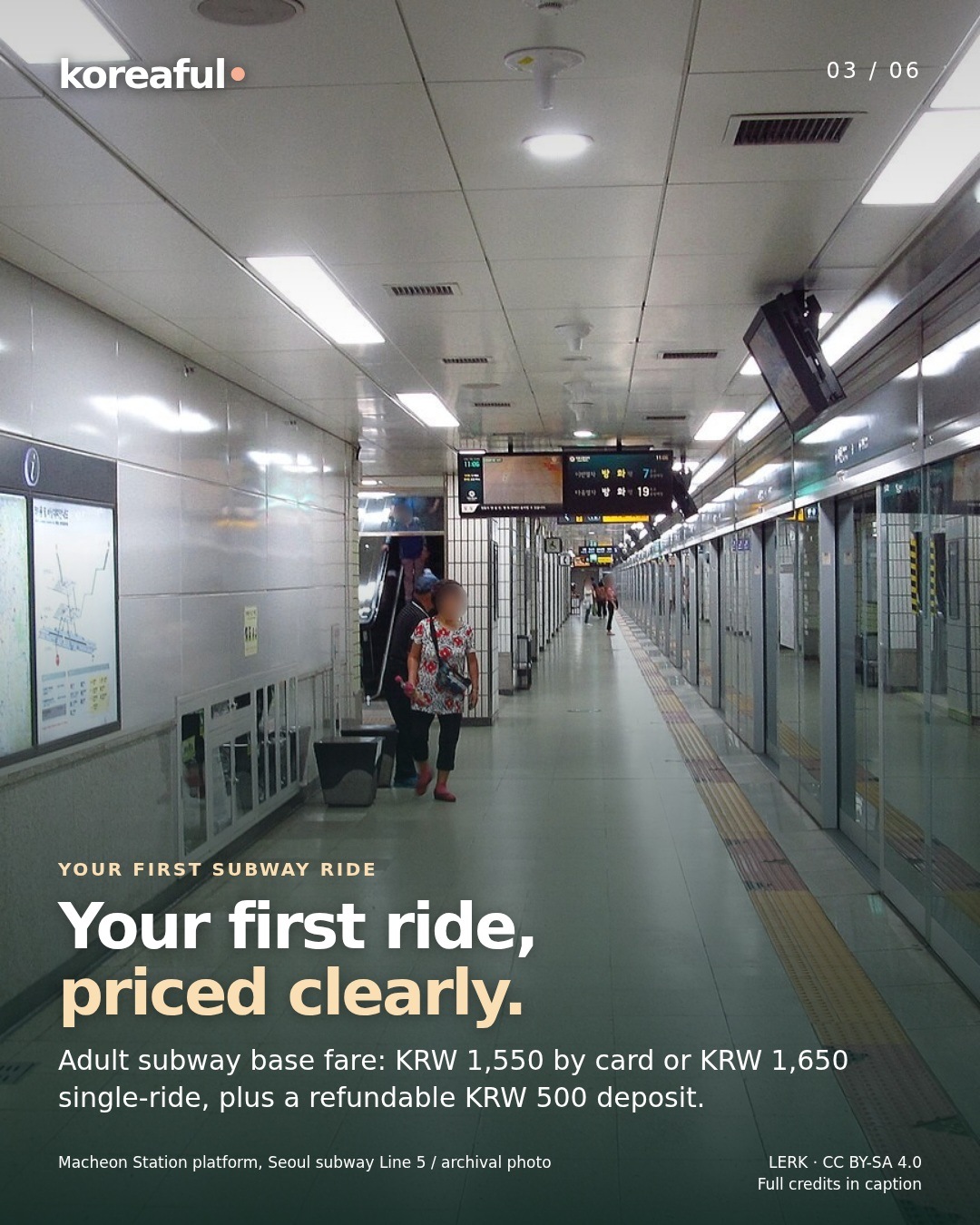
Stay inside the paid area when changing subway lines and follow the color-coded transfer signs. The fare is calculated for the journey, including distance supplements where applicable; changing lines is not a new flat-fare journey. Seoul Metropolitan Government lists the adult subway base fare as KRW 1,550 with a transport card and KRW 1,650 for a single-ride ticket, effective June 28, 2025. The KRW 500 refundable single-ticket deposit is additional to that fare.
| Service | Fare | What to allow for |
|---|---|---|
| Subway, transport card | KRW 1,550 | Base fare; distance supplements may apply. Effective June 28, 2025. |
| Subway, single-ride ticket | KRW 1,650 | Add a refundable KRW 500 card deposit; distance supplements may apply. |
| Blue or green Seoul bus | KRW 1,500 | Adult fare in the city government table effective August 12, 2023. |
- Choose your destination and route using the official map.
- Use a charged transport card, or buy a single-journey ticket at a station machine.
- Tap at the entry gate and follow signs for your line and direction.
- Follow transfer signs if your route changes lines; tap out at your destination.
- If you used a single-journey ticket, return it to the Deposit Refund Device after leaving the gates to recover the KRW 500 deposit.
Official reference: english.visitseoul.net · english.seoul.go.kr · english.seoul.go.kr · english.seoul.go.kr
Riding a Bus and Using the Transfer Discount
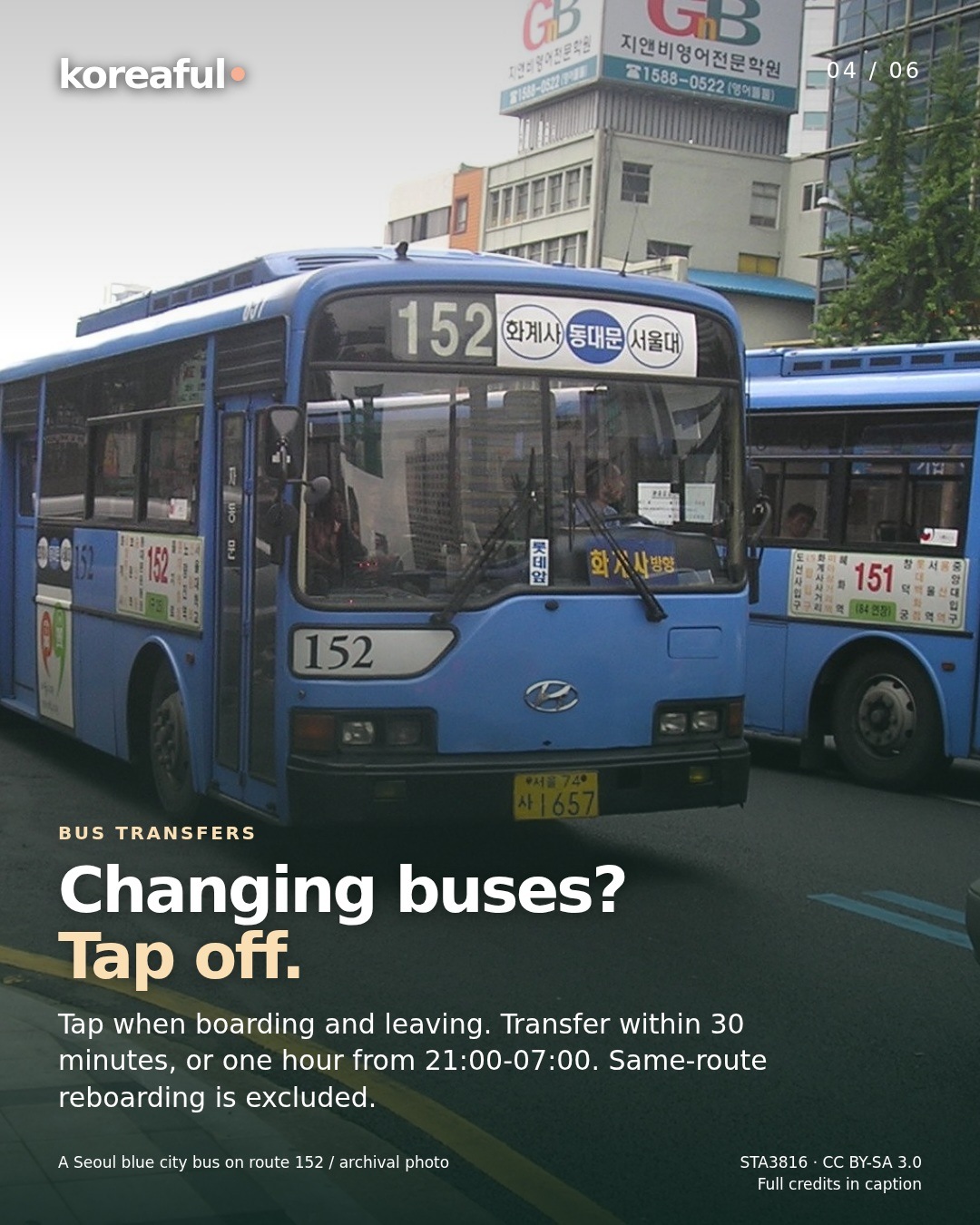
Seoul's buses are color-coded: blue buses run trunk routes between districts, green buses connect residential areas to subway stations or blue bus stops, yellow buses circulate in the city center, and red buses run express routes to surrounding areas. Bus stops can have limited English signage, so downloading a navigation app before you board is advisable.
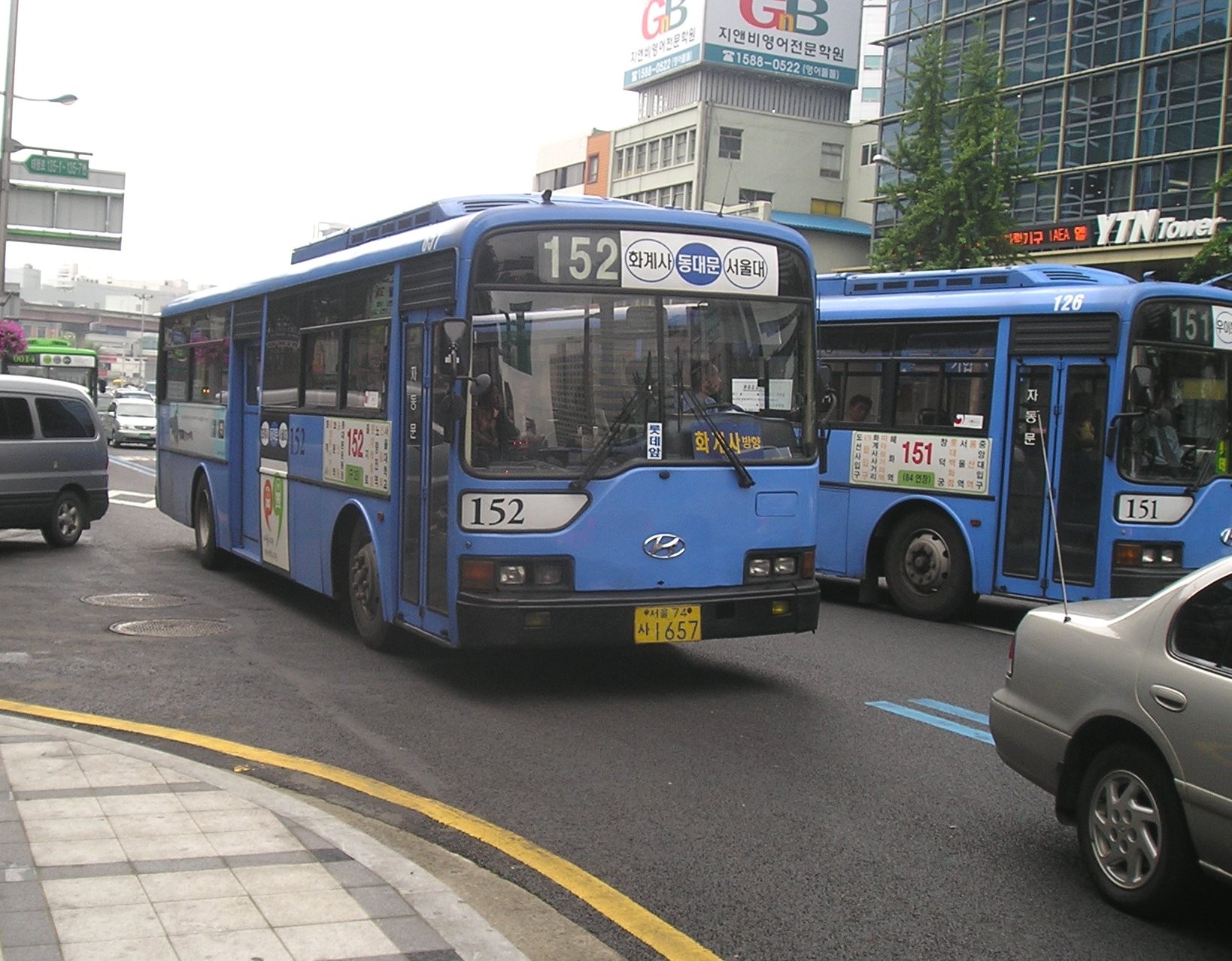
Photo credit
STA3816 / CC BY-SA 3.0. Resized/cropped for display; the photograph retains its license.

Tap the card reader when boarding and again when leaving. Visit Seoul lists up to four transfer discounts between buses and between bus and subway, with a 30-minute connection window extended to one hour between 21:00 and 07:00. Seoul Metropolitan Government explains the combined fare: it starts with the highest base fare of the services used, with KRW 100 added per 5 km beyond the basic 10 km. This is a linked-journey discount, not a promise that any four additional rides are free. A transfer back onto the same bus route is excluded.
Some buses in Seoul operate as cashless only. Visit Seoul notes that Seoul expanded its cashless bus service from March 1, 2023. Check which routes are cashless before assuming you can pay with cash on any bus.
The city government lists the adult blue and green bus fare as KRW 1,500 with either a transport card or cash, effective August 12, 2023. A valid Climate Card covers Seoul-licensed buses within its stated service range; excluded airport and intercity services still require separate payment.
Official reference: english.visitseoul.net · english.seoul.go.kr · english.seoul.go.kr · english.seoul.go.kr
What the Climate Card Does Not Cover
Climate Card coverage is a defined service area. The official exclusions include the Sinbundang Line, intercity and airport buses, and non-Seoul-licensed buses. Some subway sections extend beyond the city, so check the named stations in the official range instead of judging a journey only by a municipal boundary.
The subway service range also has a boarding-versus-alighting distinction that catches visitors out. If you board within the service range but exit at a station outside it, the pass does not apply and a station attendant will collect the fare from your boarding station to your destination. For example, boarding at Jongno 3(sam)-ga Station in Seoul and alighting at Indeogwon Station in Gyeonggi-do is not covered, even though you started in Seoul.
Some extensions permit getting off but not boarding with the pass. The service-range table identifies these exceptions, including a Line 7 extension toward Seoknam. Check both your boarding station and destination: permission to exit at a station does not by itself mean the reverse trip is covered.
For Line 1, the covered section runs from Onsu Station or Geumcheon-gu Office Station to Dobongsan Station — not the full line. The Seoul Metropolitan Government's Climate Card service range search tool (linked from its Climate Card page, in Korean) lets you check individual station eligibility before your journey.
Official reference: english.seoul.go.kr
Airport Connections: What Each Card Covers
Treat an airport journey as a separate coverage check before buying a city pass. The Climate Card page gives specific rules for the Airport Railroad section, and these are different from a blanket promise of free airport travel.
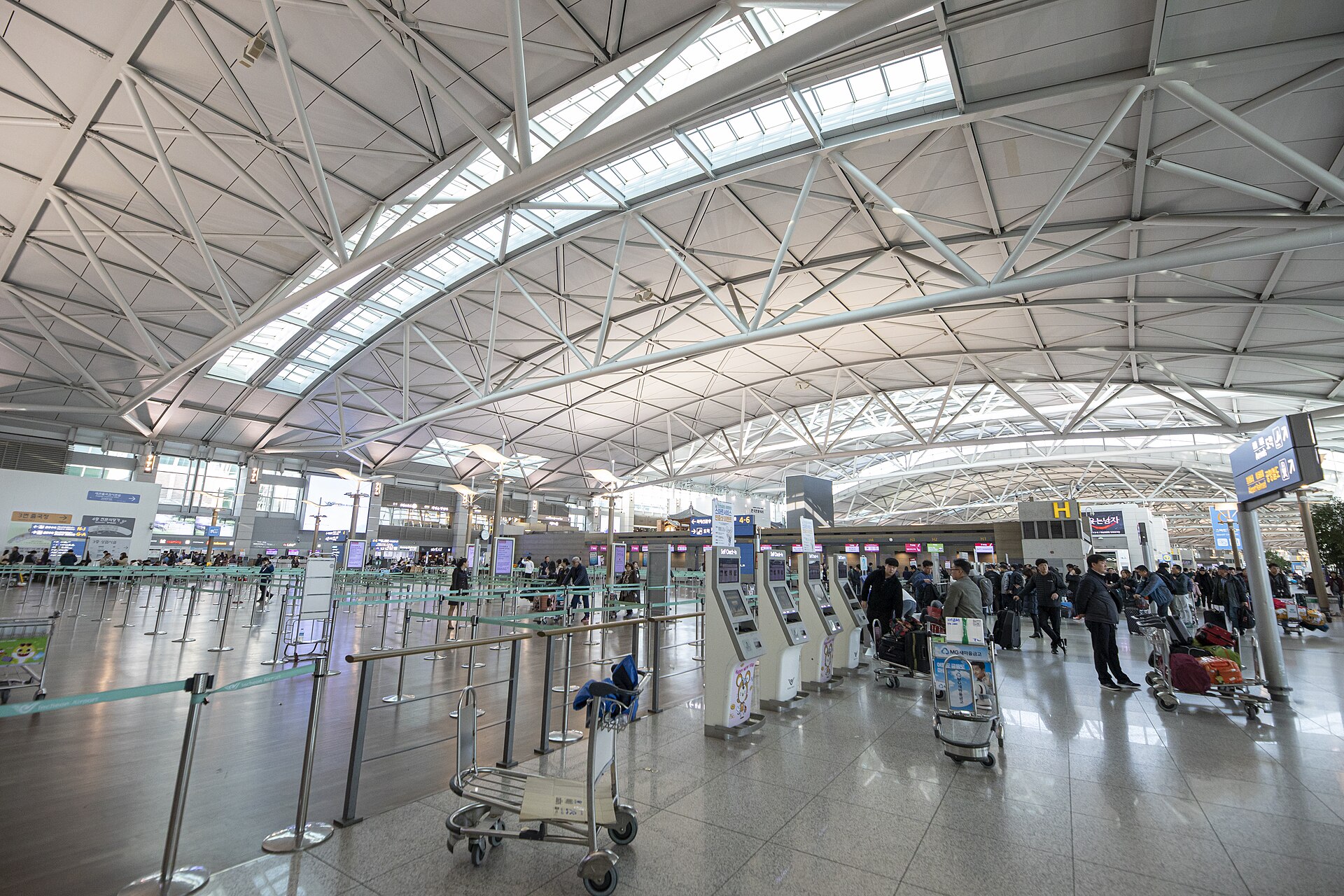
Photo credit
Arne Müseler / CC BY-SA 3.0 de. Resized/cropped for display; the photograph retains its license.

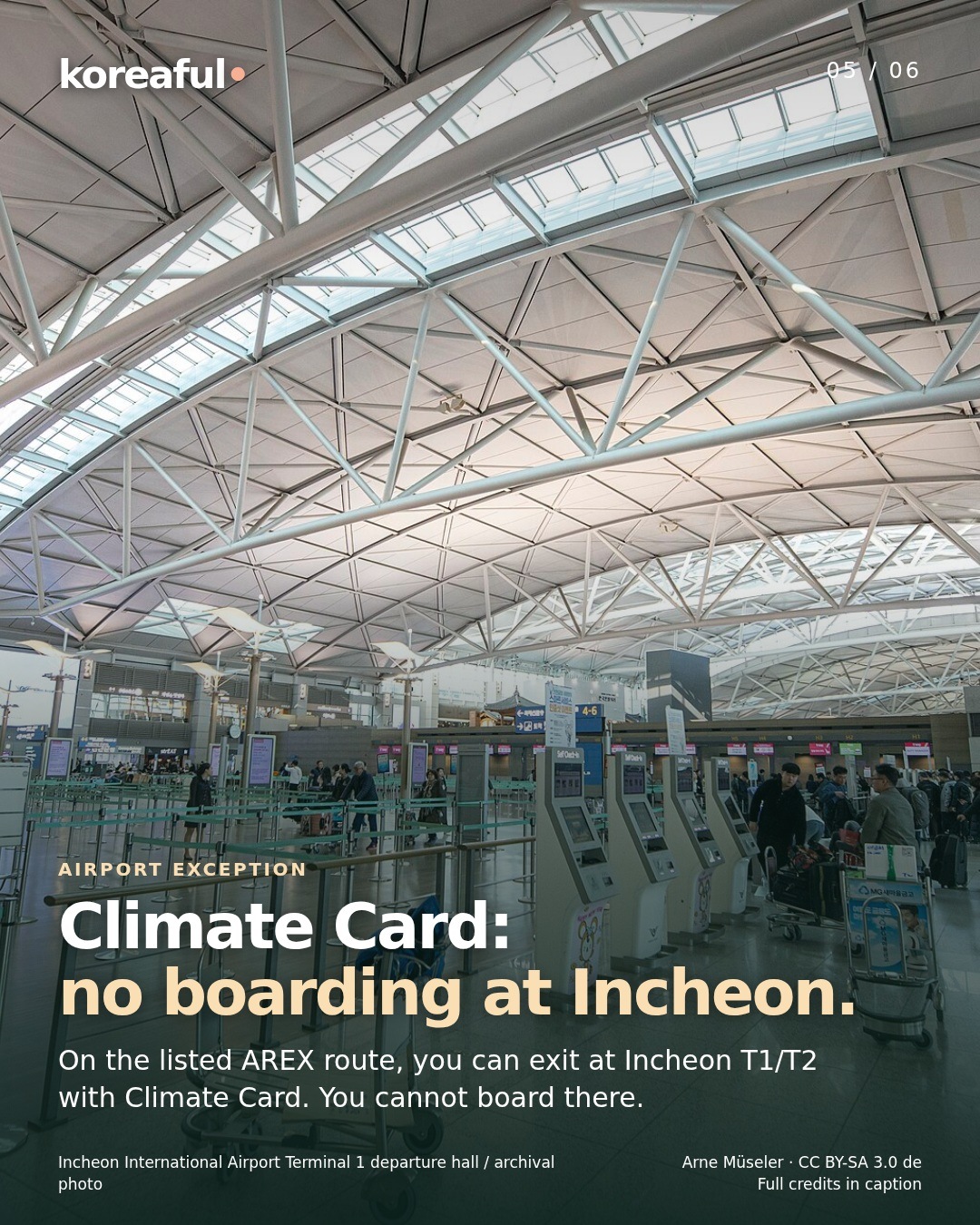
For Climate Card holders, the covered AREX section runs between Gimpo International Airport Station and Seoul Station. From September 13, 2024, you may also exit at Incheon International Airport Terminal 1 and Terminal 2 on a Climate Card — but you cannot board at T1 or T2. This means a Climate Card does not cover a journey that begins at Incheon Airport on AREX.
Visit Seoul notes additional fares for the Airport Railroad Independent Area between Cheongna International City and Incheon International Airport. Check the ticket and fare for the airport service you intend to take. A city transport pass and an airport train booking are separate decisions.
Intercity and airport buses are excluded from the Climate Card entirely. If you plan to take an airport limousine bus, you will pay that separately regardless of which card you carry.
Official reference: english.seoul.go.kr · english.visitseoul.net
If the Gate Does Not Let You Through
If a Tmoney balance is insufficient for the fare, Visit Seoul points to fare-adjustment machines near the turnstiles. Check the displayed information and add the required balance; ask station staff if you cannot resolve the problem. A gate problem should not be diagnosed from its sound alone.
For a Climate Card journey, check pass validity and both stations in the service range. Also consider whether the missed-exit-tap suspension applies. Short-term passes begin on their recharge date and cannot be charged in advance, according to the Seoul Metropolitan Government, so plan the recharge around the first day you want to use the pass.
If your registered Climate Card is lost or defective, the Seoul Metropolitan Government notes that refunds may be difficult if the card is not in the user's own name, and that foreigners without a Korean bank account can visit Tmoney headquarters in person to request a refund.
Official reference: english.seoul.go.kr · english.visitseoul.net
Official Maps and the Final Card Check
Start with the official transportation page from Visit Seoul. It provides an interactive subway map for checking routes, estimated fares and travel times, and a downloadable map. Save the static map before travelling if you want an offline reference; do not assume a route-planning app works offline unless that app confirms it.
For a Climate Card trip, use the separate service-range search linked by Seoul Metropolitan Government, then compare that result with your route. A subway map helps plan where to go; the pass coverage check answers whether your chosen payment option covers the trip. Keep both official pages with your travel notes.
Visit Seoul also lists M-Pass, allowing up to 20 public-transport journeys per day, purchased at Seoul Station Tmoney Town. It describes validity as one month from purchase, with activation on use. Check its pass-specific duration and conditions there before buying; this guide compares Tmoney and short-term Climate Card for the routes above.
Official reference: english.visitseoul.net
Sources and trip notes
Official information checked 15 September 2026. Routes are editorial suggestions. Check date-specific conditions with the operator before travel; photographs are archival.
TAKE THE SHORT VERSION WITH YOU
Your trip highlights, ready to save.
On the listed AREX route, you can exit at Incheon T1/T2 with Climate Card. You cannot board there.
Save the highlights or send them to your travel buddy.
Seoul · 6-CARD GUIDE
Seoul Public Transportation: Choose Your Card and Make Your First Trip
On the listed AREX route, you can exit at Incheon T1/T2 with Climate Card. You cannot board there.
Photo credits
Your Seoul group chat needs one transport plan.
Tmoney: pay per ride. Short-term Climate Card: unlimited rides within its covered services.
The airport catch: Climate Card allows exit at Incheon T1/T2, not boarding there.
Are you planning lots of city trips or just a few?
#Seoul #KoreaTravel #SeoulSubway #Koreaful
Photo credits (archival photographs; cropped with text):
Banghwa Station platform, Seoul subway Line 5: LERK / CC BY-SA 4.0
https://commons.wikimedia.org/wiki/File:Seoul-metro-510-Banghwa-station-platform-20180914-173620.jpg
https://creativecommons.org/licenses/by-sa/4.0
Ticket vending and card reload machine at Soraepogu Station, Incheon (2024): LandAndTree / CC BY 4.0
https://commons.wikimedia.org/wiki/File:Ticket_Vending_and_Card_Reload_Machine_-_Seoul_Metropolitan_Subway_20240713.jpg
https://creativecommons.org/licenses/by/4.0
Macheon Station platform, Seoul subway Line 5: LERK / CC BY-SA 4.0
https://commons.wikimedia.org/wiki/File:Seoul-metro-P555-Macheon-station-platform-20180915-110842.jpg
https://creativecommons.org/licenses/by-sa/4.0
A Seoul blue city bus on route 152: STA3816 / CC BY-SA 3.0
https://commons.wikimedia.org/wiki/File:Seoul_City_Bus_152.jpg
https://creativecommons.org/licenses/by-sa/3.0
Incheon International Airport Terminal 1 departure hall: Arne Müseler / CC BY-SA 3.0 de
https://commons.wikimedia.org/wiki/File:Incheon_International_Airport_Terminal_1_Departure.jpg
https://creativecommons.org/licenses/by-sa/3.0/de/deed.en
KEEP THE GOOD FINDS
This could be part of your Korea.
Save this guide alongside your other ideas. You can come back to compare, plan, or explore something new.