Seoul Public Transport Cost: What You Actually Pay Per Ride, Per Day and Per Week
Using a transit card, adults pay ₩1,300 for a standard subway or trunk-bus ride inside Seoul's base 10 km zone — and the integrated transfer discount means most multi-leg tourist journeys stay at or very close to that base fare. The main decision is whether to load a pay-as-you-go T-money card or buy the Climate Card Short-Term Pass, which offers unlimited rides from ₩5,000 per day.
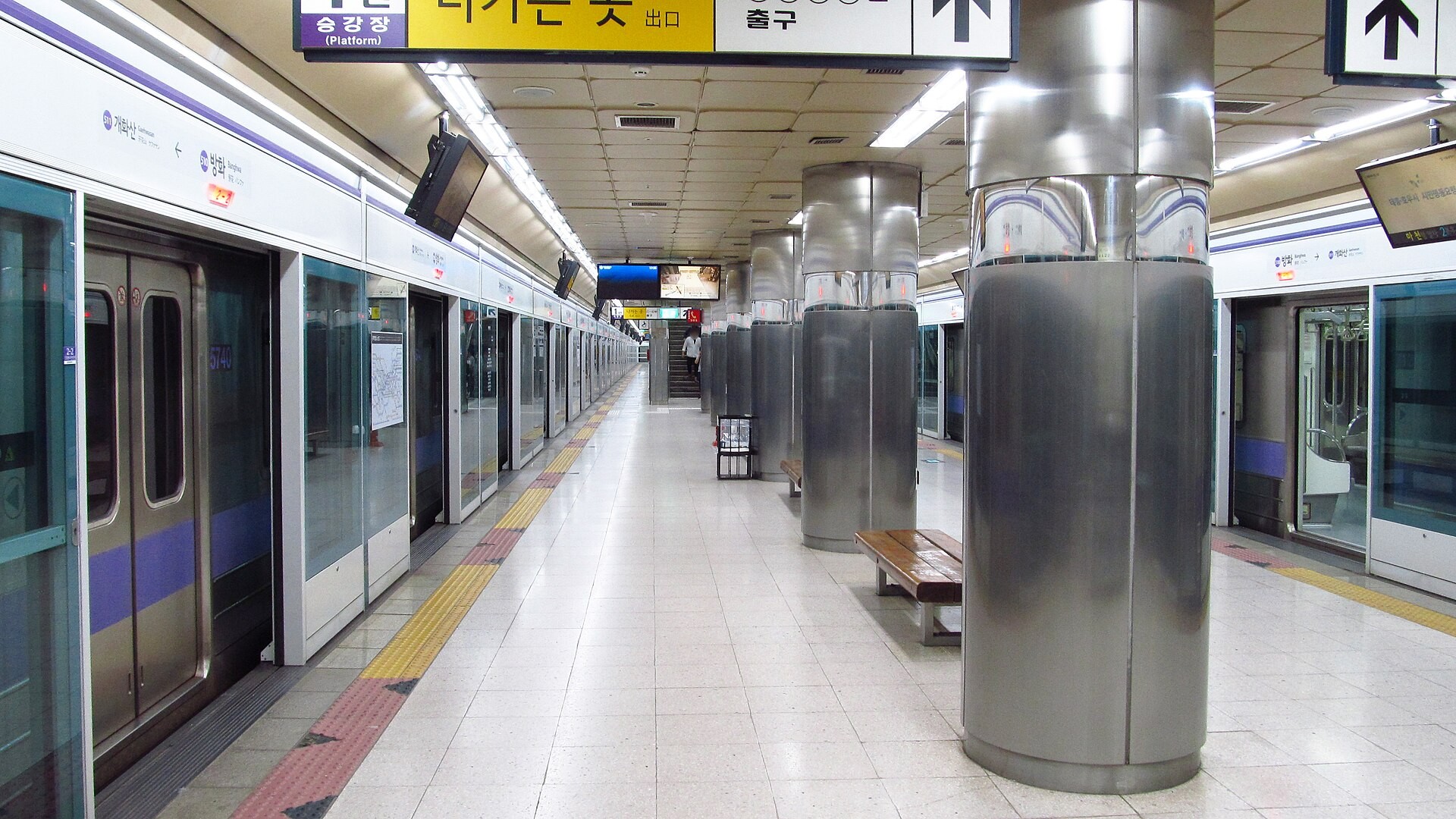
Photo credit
LERK / CC BY-SA 4.0. Resized/cropped for display; the photograph retains its license.

The base fare and who pays what
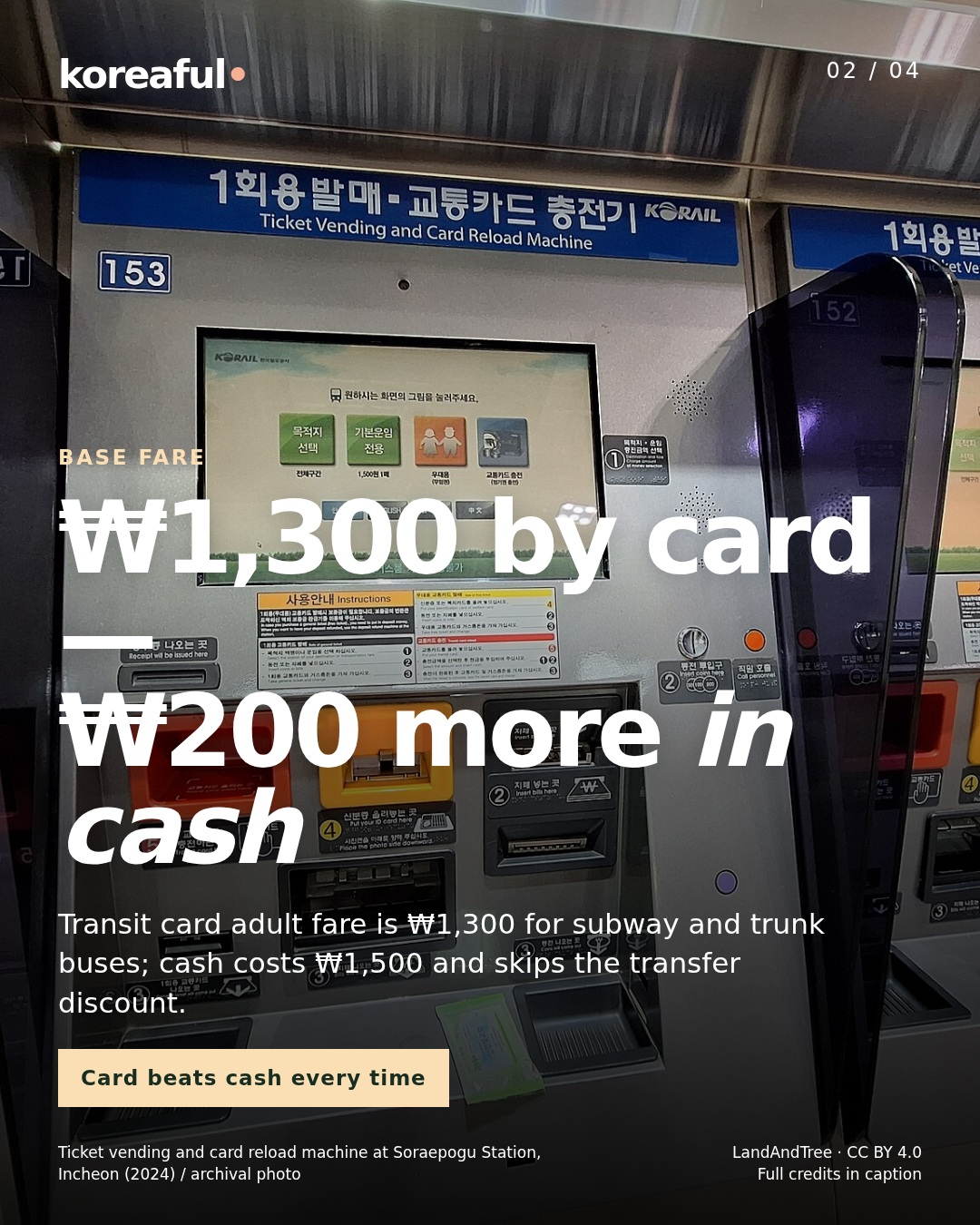
Seoul's integrated transit system charges a single base fare for the first 10 km regardless of whether you start on the subway or a trunk or branch bus — as long as you pay by card. For adults using a T-money, Cashbee or compatible transit card, that base fare is ₩1,300 on the subway and on trunk and branch buses. Paying cash on a bus costs ₩1,500 for the same ride — a ₩200 penalty per trip that adds up quickly over a week of sightseeing.
Children (ages 6–12) and teenagers (ages 12–18) pay reduced card fares, but teens must register their date of birth on the card at purchase to unlock the discount. Infants under six ride free when accompanied by an adult guardian, up to three per adult. Single-journey paper tickets on the subway attract a ₩100 deposit on top of the fare, refunded at exit machines — they also do not qualify for the transfer discount, making a transit card the default choice for anyone making more than one ride.
Rapid buses — the red inter-regional routes connecting outer suburbs to central Seoul — carry a higher adult card fare of ₩2,400, and circulation (yellow) buses charge ₩1,200 by card. Owl night buses have their own fare structure. For most tourist itineraries centred on inner Seoul, trunk and branch buses and the subway are the relevant modes, both at the ₩1,300 card base fare.
Official reference: english.seoul.go.kr · english.visitkorea.or.kr
How the distance surcharge works — and when tourists actually hit it
Beyond the 10 km base zone, an additional ₩100 is charged for every 5 km travelled on a single continuous journey. The surcharge applies across the entire integrated trip, not per vehicle — so a subway-to-bus transfer that together covers 16 km would incur one ₩100 surcharge, not two.
For most inner-city tourist routes — Gyeongbokgung to Myeongdong, Hongdae to Itaewon, Insadong to Dongdaemun — distances stay comfortably within the 10 km base zone and the surcharge simply does not apply. Longer cross-city routes, such as trips to Lotte World in Jamsil from central Seoul, or any journey that extends toward the outer ring of the metro area, may attract one or two surcharge increments. Airport-area subway journeys on standard lines (not the AREX express) can trigger surcharges given the greater distances involved.
The surcharge calculation resets each time you complete a trip and start a new one, so the key is understanding what counts as one continuous journey — and that brings us to the transfer rules.
Official reference: english.seoul.go.kr
Tapping on and off: the transfer discount rule tourists most often miss
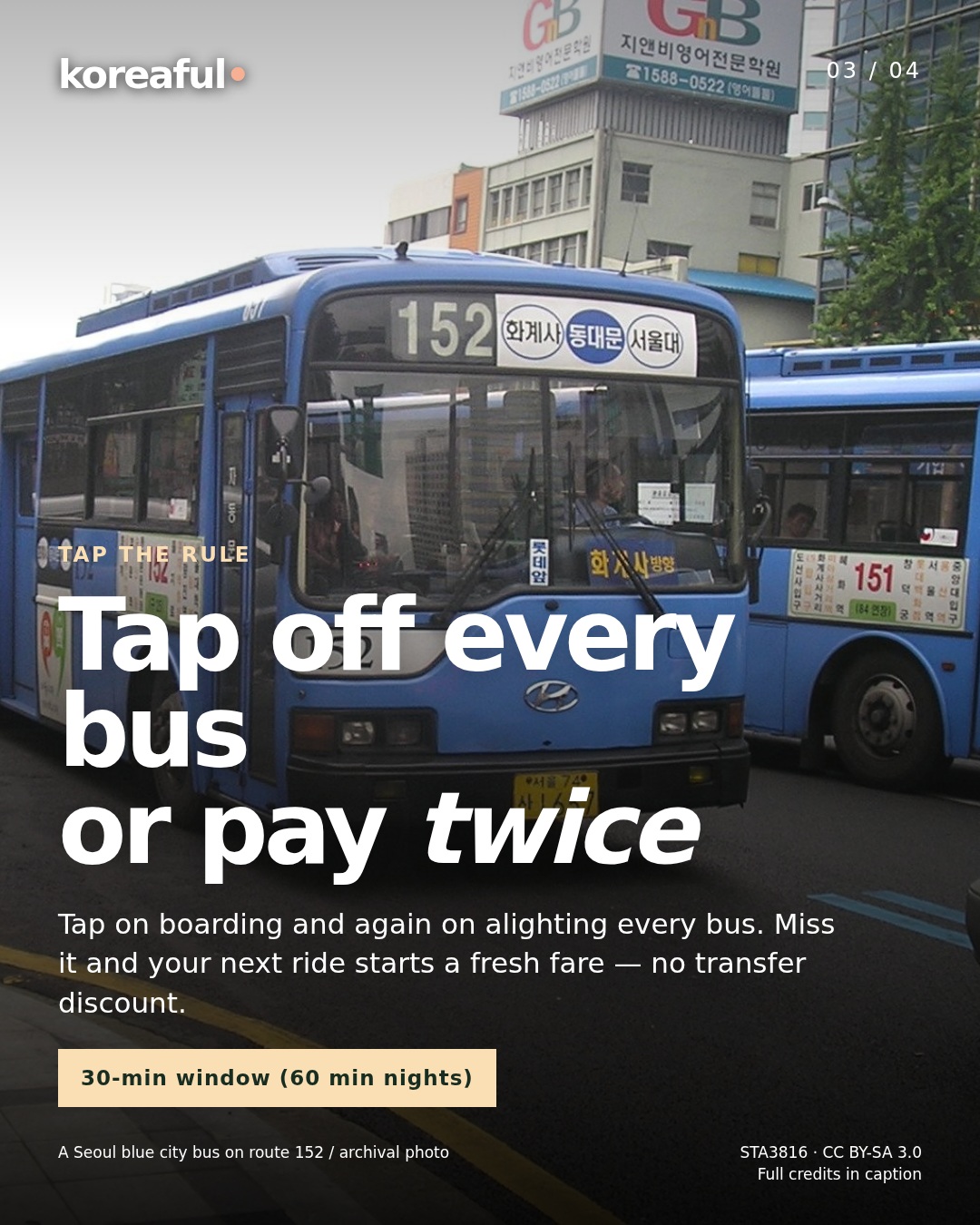
The integrated transfer discount is the single biggest fare-saving mechanism in Seoul's system, and it depends entirely on tapping your card correctly at every step. When you board a bus, tap on. When you alight, tap off. On the subway, tap through the entry gate and again through the exit gate. Miss either tap and the system treats your next boarding as a fresh journey at full base fare.
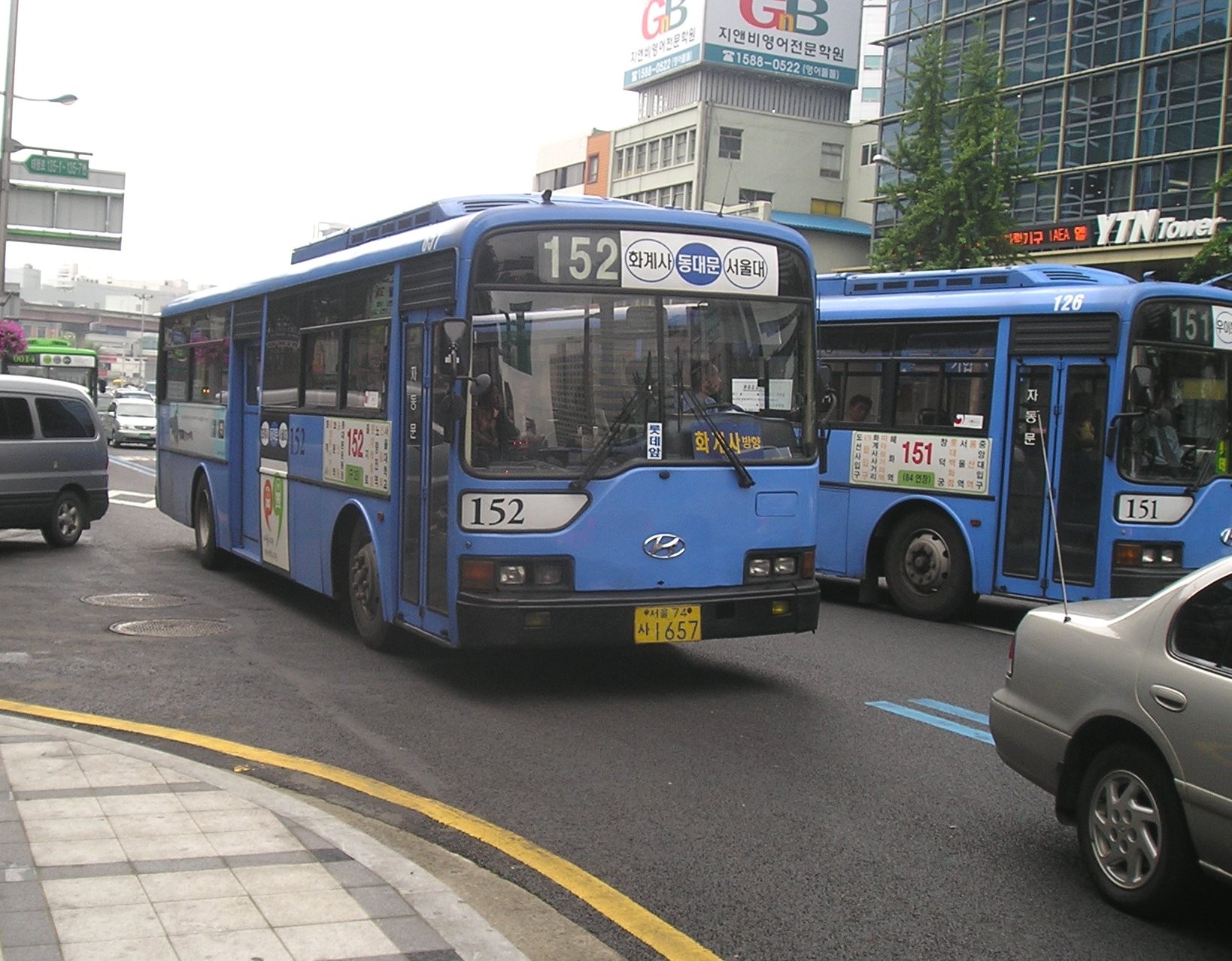
Photo credit
STA3816 / CC BY-SA 3.0. Resized/cropped for display; the photograph retains its license.

After tapping off, you have 30 minutes to board your connecting vehicle for the transfer to count as the same journey. Between 9 PM and 7 AM, that window extends to 60 minutes. You can transfer up to four times (five boardings in total) on one continuous trip. The same bus route and same vehicle do not qualify — re-boarding the bus you just left triggers a new fare.
- Board bus or enter subway gate: tap card on reader
- Alight bus: tap card on the exit reader before leaving
- Exit subway: tap card through the exit gate
- Board connecting vehicle within 30 minutes (60 min, 9 PM–7 AM) for transfer discount
- Repeat up to four transfers (five boardings) on one continuous journey
Official reference: english.seoul.go.kr
Getting your card: T-money, Cashbee and where to buy
T-money is the most widely accepted transit card in Seoul, usable on the subway, all bus types, taxis, and at a large network of affiliated convenience stores and vending machines. Cashbee works the same way across the transit system. Both are sold at convenience store chains — GS25, CU, 7-Eleven and others — nationwide, and at Seoul Metro Information Centers on Lines 1 to 8. Cards cost between ₩3,000 and ₩5,000 depending on the design, and you add a separate balance to ride.
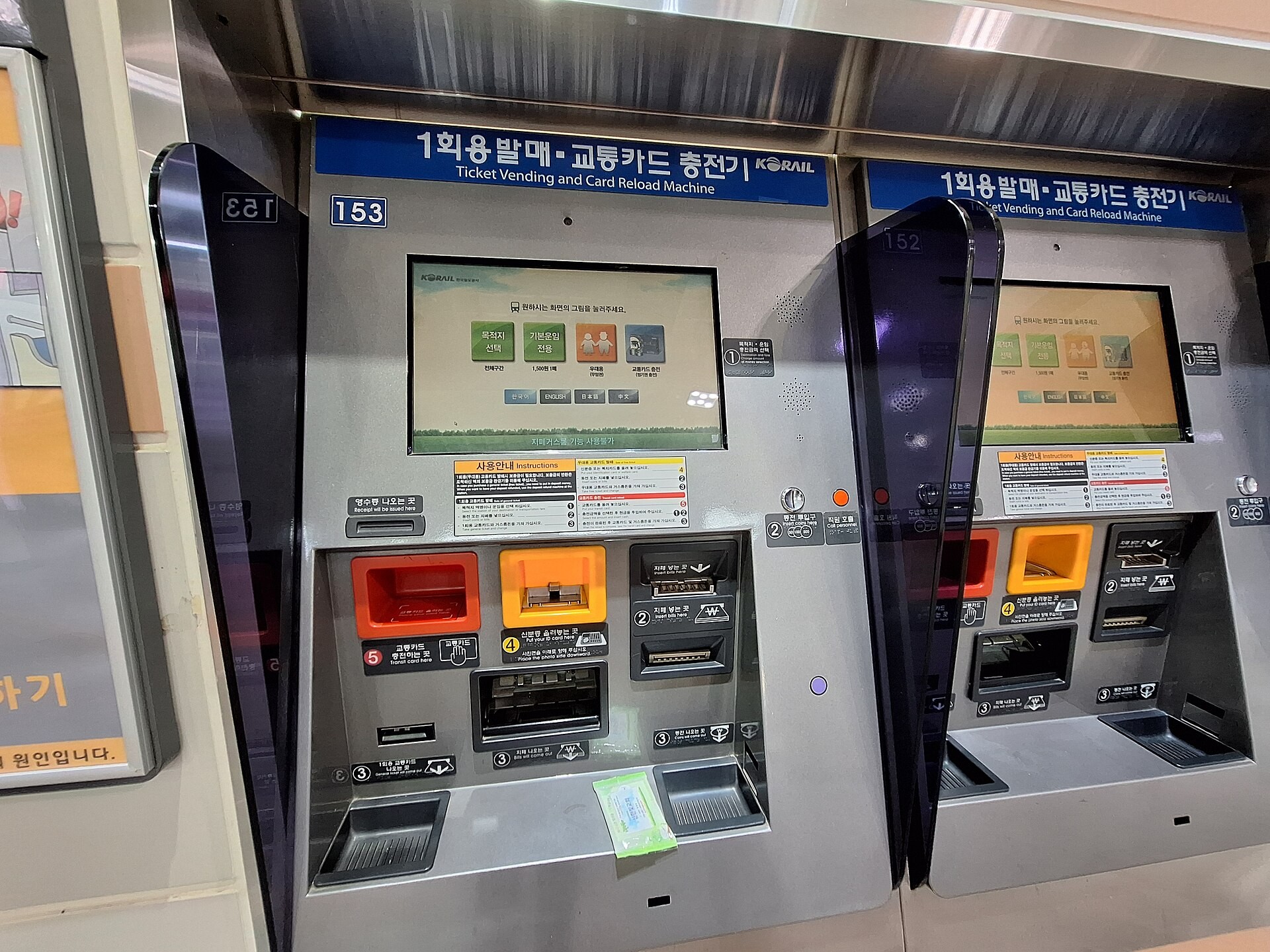
Photo credit
LandAndTree / CC BY 4.0. Resized/cropped for display; the photograph retains its license.

You can reload both cards at subway ticket vending machines (up to ₩500,000 total balance), and at convenience stores. Some machines accept international credit or debit cards for reloads — but the physical card itself typically needs to be purchased with Korean won cash at a convenience store. Travellers arriving at Incheon Airport can pick up a T-money or EZL card at airport convenience stores before boarding the AREX.
The WOWPASS, a foreigner-exclusive card that also handles currency exchange, can be purchased at kiosks in airports and major subway stations using a passport. It functions as a transit card and allows reload in foreign currencies at WOWPASS kiosks. For transit purposes it works like T-money, but the primary appeal is the currency exchange and shopping payment function.
Official reference: english.visitkorea.or.kr
Comparison: pay-as-you-go vs Climate Card vs Mpass vs Discover Seoul Pass
Four payment formats are available to international visitors. Which makes financial sense depends on how many rides you take per day, how long you stay, and whether you have Korean won cash on hand.
Note that as of October 2026, the Climate Card is available only as a Short-Term Pass (1–7 days); the 30-day prepaid and postpaid formats have been discontinued. The short-term pass activates from the moment it is loaded, so purchase it on the morning you first plan to use it rather than the night before.
| Option | Cost | Ride limit | Buy with foreign card? | Best for |
|---|---|---|---|---|
| T-money / Cashbee (pay-as-you-go) | Card ₩3,000–₩5,000 + balance loaded | Unlimited (balance-based) | Reload possible at select kiosks; card typically needs Korean won cash at convenience stores | Most visitors; flexible, widely accepted across transit and shops |
| Climate Card Short-Term Pass | ₩5,000 (1-day) / ₩8,000 (2-day) / ₩10,000 (3-day) / ₩15,000 (5-day) / ₩20,000 (7-day) + ₩3,000 physical card | Unlimited rides on Seoul subway lines and buses (excl. Sinbundang Line & GTX) | Korean-issued cards or cash only at station kiosks and convenience stores | 3+ rides/day; stays of 1–7 days; visitors who want a spending cap |
| T-money Mpass (foreigner-only) | ₩15,000 (1-day) / ₩23,000 (2-day) / ₩30,500 (3-day) / ₩47,500 (5-day) / ₩64,500 (7-day) | Up to 20 rides/day; also covers AREX all-stop trains (not express) | No — Korean won cash only at Tmoney Town, Seoul Station Exit 10 | Heavy daily users or those including regular airport rail trips on all-stop AREX |
| Discover Seoul Pass | Varies by duration (check operator for current pricing) | No unlimited subway/bus; transit card must be topped up separately | Yes — online and at designated sales points | Attraction-focused itineraries; transit savings are not the primary value |
Official reference: english.visitkorea.or.kr
Realistic daily and weekly transport budget
A typical tourist day in inner Seoul involves three to five transit rides: getting to the first sightseeing area, moving between neighbourhoods mid-day, and returning to the accommodation. At ₩1,300 per ride on a transit card, that comes to roughly ₩3,900–₩6,500 per adult per day, assuming most journeys stay within the 10 km base zone and you tap correctly to qualify for transfer discounts.
Across a seven-day trip, pay-as-you-go spending for that activity level would land in the range of ₩27,000–₩45,000 in transit fares, before adding the one-time card cost of ₩3,000–₩5,000. The Climate Card 7-day pass at ₩20,000 (plus the ₩3,000 card) caps that spending at ₩23,000 total, representing clear savings for active sightseers.
Official reference: english.visitkorea.or.kr · english.seoul.go.kr
First step: which card to get on or before arrival
For most international visitors, the practical sequence is: pick up a T-money or EZL card at an Incheon Airport convenience store immediately on arrival, load ₩20,000–₩30,000 in Korean won cash, and use it for your first rides. Once you have a sense of how many rides per day your itinerary actually involves, decide on Day 1 or 2 whether to switch to the Climate Card Short-Term Pass for the remainder of your stay.
If you know in advance that you will take four or more rides daily and stay three or more days, buying a Climate Card Short-Term Pass at a subway station Information Center or kiosk on your first morning is the more efficient move. Load the correct pass duration in one step and you are done with fare calculations for that period.
- On arrival at Incheon Airport: buy a T-money or EZL card at an airport convenience store with Korean won cash
- Load ₩20,000–₩30,000 to cover first one or two days
- Always tap on boarding and tap again when alighting buses; tap entry and exit gates on the subway
- After Day 1, count your rides: if averaging 4+ per day, buy a Climate Card Short-Term Pass at a subway station kiosk for the remaining days
Official reference: english.visitkorea.or.kr
Sources and trip notes
Official information checked 19 September 2026. Routes are editorial suggestions. Check date-specific conditions with the operator before travel; photographs are archival.
TAKE THE SHORT VERSION WITH YOU
Your trip highlights, ready to save.
Tap on boarding and again on alighting every bus. Miss it and your next ride starts a fresh fare — no transfer discount.
Save the highlights or send them to your travel buddy.
Seoul · 4-CARD GUIDE
Seoul Public Transport Cost: What You Actually Pay Per Ride, Per Day and Per Week
Tap on boarding and again on alighting every bus. Miss it and your next ride starts a fresh fare — no transfer discount.
Photo credits
₩1,300 per ride with a transit card — and most inner-city tourist trips stay right there. The transfer discount links your bus and subway legs into one fare, but only if you tap off every bus before you switch. Heading out for a full week? The Climate Card 7-day pass (₩20,000 + ₩3,000 card) beats pay-as-you-go for anyone taking 4+ rides a day. Which card did you end up using in Seoul — T-money or one of the tourist passes? #Seoul #SeoulTravel #KoreaTravel #SeoulTransport #VisitKorea
Photo credits (archival photographs; cropped with text):
Banghwa Station platform, Seoul subway Line 5: LERK / CC BY-SA 4.0
https://commons.wikimedia.org/wiki/File:Seoul-metro-510-Banghwa-station-platform-20180914-173620.jpg
https://creativecommons.org/licenses/by-sa/4.0
Ticket vending and card reload machine at Soraepogu Station, Incheon (2024): LandAndTree / CC BY 4.0
https://commons.wikimedia.org/wiki/File:Ticket_Vending_and_Card_Reload_Machine_-_Seoul_Metropolitan_Subway_20240713.jpg
https://creativecommons.org/licenses/by/4.0
A Seoul blue city bus on route 152: STA3816 / CC BY-SA 3.0
https://commons.wikimedia.org/wiki/File:Seoul_City_Bus_152.jpg
https://creativecommons.org/licenses/by-sa/3.0
KEEP THE GOOD FINDS
This could be part of your Korea.
Save this guide alongside your other ideas. You can come back to compare, plan, or explore something new.